
Citrus Heights Leak Detection and Repair Services: 7 Ways to Spot Hidden Plumbing
Leaks
Hidden plumbing leaks can ruin your cabinets, buckle floors, and even spike your monthly bills. To avoid such catastrophe, try these seven proven water leak detection steps to catch small issues before they become big repairs. We’ll show you what to check, how to test, and when to call a pro. Plus, Sacramento homes face hard water and pressure swings, so these tips include local insight to protect your plumbing and budget!
#1: Start With a Whole-Home Water Meter Test
A whole-home water meter test is the fastest way to confirm a hidden leak without having to open up any walls:
- Turn off all fixtures and water-using appliances. Check hose bibs and fridge lines too.
- Locate your water meter. Note the flow indicator or record the reading.
- Wait 30 to 60 minutes without using water. If the indicator moves or the reading increases, water is escaping somewhere.
Why It Works: The meter sees every drop. If it moves while the house is “off,” there’s a supply leak or a running fixture that you likely missed. Repeat the same test after shutting the main water valve to your house. If movement stops, the leak is inside. If it continues, the leak may be on the service line between the meter and your home.
Local Tip: Older Sacramento neighborhoods with large trees can experience root pressure on service lines. If the meter shows flow with the house valve off, ask about a camera inspection and pressure test on your main line.
#2: DyeTest Toilets for Silent Leaks
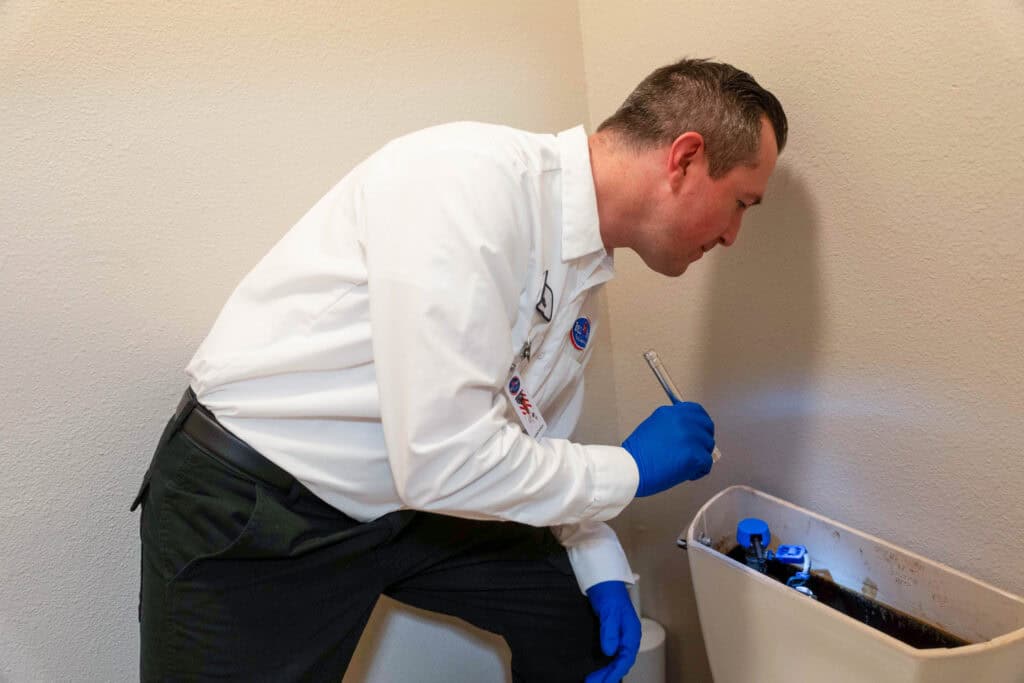
Did you know that toilets can waste hundreds of gallons a day without making a single sound? Remove the tank lid, add five to ten drops of food coloring to the tank, and wait 10 minutes without flushing. If color appears in the bowl, water is leaking past the flapper. Fixes you can try:
- Wipe the flapper and seat to remove mineral buildup.
- Replace if the flapper is warped or stiff. Match the model for correct flush volume.
- Check the fill valve and overflow tube height.
Why This Matters: EPA WaterSense estimates that 10% of homes have leaks that waste 90+ gallons per day, and toilets are a top culprit! In the Sacramento region’s hardwater zones, mineral scale accelerates flapper wear. A quick flapper swap often pays back in a month on your water bill.
#3: Check Fixture Supply Lines and Shutoff Valves
Hidden leaks often start at the braided lines under sinks, behind toilets, and at laundry faucets. Run your hands along the line and valve body to feel for moisture. Use a dry tissue to spot small weeps that evaporate quickly. What to look out for:
- Corrosion or green staining on copper stubs or valve stems.
- Bulging on braided lines or dampness at the crimp.
- Salty or white scale around compression joints.
Tighten gently if a nut has backed off, but do not overtorque. Replace any hose that shows bulging or rust at the ferrule. If a stop valve will not fully close, it is safer to replace the valve than to force it. Consider upgrading to stainless braided lines with integral ballvalve stops for kitchens and laundry rooms.
#4: Inspect Walls, Floors, and Cabinets for Subtle Signs
Not all leaks are visible! Look for:
- Swollen particleboard under sink bases
- Warped baseboards or cupped hardwood near bathrooms
- Discolored drywall or bubbling paint along ceiling lines
- Musty odors in enclosed cabinets or closets
Sacramento and Elk Grove have many slab-on grade homes where pinhole slab leaks rise as warm floor spots or unexplained moisture at baseboards. Use a simple infrared thermometer to scan for temperature anomalies along hot water paths. If the reading is warmer in a straight line across the floor with no heat source, you may have a hotside slab leak.
When to Escalate: If you notice any persistent musty smells, recurring “ghost” stains, or soft floors. These signs all point to ongoing moisture that can grow mold and attract pests. Professional acoustic or thermal imaging can pinpoint the source without opening large sections of wall in your house.
#5: Listen and Isolate With the Main Shutoff
Quiet your house at night. Put your ear to suspect walls or place a screwdriver tip on the wall with the handle to your ear. A steady hiss can signal a pressurized leak. Next, use the isolation method:
- Close the main house shutoff valve. If the hiss stops, the leak is on the house side.
- Reopen the main line, then close the branch valves to zones like the water heater, irrigation, or specific fixture groups to narrow the area.
- Check the water heater relief line for drips into the drain. A failing valve can mimic a hidden leak.
Pro Move: Measure water pressure with a gauge on a hose bib. California plumbing code requires pressure regulation when static pressure exceeds 80 psi. If you read 85 to 100 psi, install or service a pressure reducing valve. High pressure creates leaks at weak points and shortens appliance life.
#6: Crawlspace, Attic, and Exterior Sweep
Leaks love to sneak into the places that we rarely see. Grab a bright flashlight, knee pads, and a dust mask, and take a look in the following areas:
- Crawlspace – Scan for fresh dripping, bright green or white mineral tracks, and wet insulation. Check beneath bathrooms and kitchens first.
- Attic – Look for water trails along vent stacks or around your water heater if one is installed in the space.
- Exterior – Inspect hose bibs, irrigation backflow preventers, and the water service entry. Puddles or lush grass along the main route point to a buried leak.
If you notice pooled water but no obvious source, a camera inspection through a cleanout can reveal cracked drain lines that leak intermittently. Pairing a camera inspection with a pressure test helps separate drain issues from supply leaks.
#7: Know When to Call Pros for Non-Destructive Leak Detection
DIY methods can help confirm the problem, but professionals pinpoint it fast and cleanly. Modern leak detection uses acoustic listening, thermal imaging, tracer gas, and cameras to locate the exact failure point. That accuracy reduces drywall cuts, speeds repairs, and preserves finishes. Here are some major advantages of utilizing professional leak detection and repair services:
- Sameday diagnostics with onsite reports and a clear repair plan
- Trenchless options for main or sewer leaks to minimize digging
- Fully stocked trucks to complete many repairs on the first visit
Always choose a company with a state license, strong guarantees, and real reviews. Bell Brothers is licensed in California (CSLB# 726129), A+ rated by the BBB, and offers a No Surprise Guarantee so the price you approve is the price you pay. If a leak is tied to aging or corroded piping, ask about targeted repipes to stop recurring failures in the same area.
Preventive Steps to Avoid Future Leaks
Smart prevention certainly beats emergency cleanup! Add these key steps to your home routine:
- Annual plumbing safety inspection with pressure test and valve checks
- Replace washing machine hoses every 5 years or sooner if worn
- Install water hammer arrestors on noisy lines to reduce shock
- Maintain water pressure between 55 and 70 psi with a quality PRV
- Add smart leak sensors under sinks, behind toilets, and near the water heater
Membership programs that include drain clearing and inspections can help catch small issues early. In the Sacramento area, mineral scale and pressure fluctuations are common, so proactive service pays for itself by avoiding water damage and insurance claims.
Special Offer: Save on Professional Leak Detection
Save $200 on Moen Water Leak Detection with same day service. If we do the work, we will waive the diagnostic charge. Call (916) 259-8590 or schedule at https://bellbroshvac.com/ to claim your savings while appointments last.
What Homeowners Are Saying
“Called about a water leak. Was given a same day appointment. Travis was knowledgeable, friendly, and courteous. The price he quoted is the price we paid.” –Geneva N., Plumbing
“I had a leak under the kitchen sink last week. I called Bell Brothers and an hour later they arrived ready to fix the issue. They were fast, efficient, clean, and polite. I highly recommend them for all your plumbing needs. Thanks to our technician, Matthew and his helper for first class service!” –Marcia H., Plumbing
“Keith came to our home to fix a leak at the shower faucet. It turned out to be a more complex job than either of us expected, but he devoted his time diligently to finding the correct part, installing it, and completing the project competently. Keith and the Bell Brothers plumbers and HVAC people generally are consistently capable and efficient.” –Paul S., Plumbing
“Had your Technician Scott Weiss over this weekend with a messy water leak, and in short, he got that and more all taken care of quickly and professionally. He’s a terrific guy, pleasant, knowledgeable, and prompt. We’ve never had a Bell Bros tech that wasn’t a pro, but Scott was a life saver.” –Mark P., Plumbing
Frequently Asked Questions About Leak Detection and Repair
Q: How do I tell if I have a hidden leak without opening walls?
A: Turn off all water in your home and watch the water meter for 30 to 60 minutes. If it moves, there is a leak somewhere. Next, close the house main. If movement stops, the leak is inside. If not, suspect the service line.
Q: Does food coloring in the toilet really work?
A: Yes! Add dye to the tank and wait 10 minutes. Color in the bowl without flushing means the flapper is leaking. Replacing the flapper is an easy, low cost fix that often even lowers your water bill!
Q: What are common signs of slab leaks?
A: Common signs of a slab leak include warm floor spots, sudden water bill spikes, hissing in walls, or damp baseboards on slab-on grade homes. You may also see rapid meter movement with fixtures off. Thermal imaging helps confirm hotside slab leaks.
Q: What water pressure is too high for a home?
A: Anything above 80 psi is considered excessive in California and requires pressure regulation. The ideal range is 55 to 70 psi. High pressure accelerates leaks, shortens appliance life, and can cause water hammer.
Q: When should I call a pro instead of DIY?
A: Call a professional if the meter shows flow but you can’t isolate the source, you suspect a slab or main line leak, or you see recurring moisture or musty odors. Professionals use acoustic, thermal, and camera tools to locate the exact point with minimal damage.
The Bottom Line
You can catch most hidden leaks early with a meter test, toilet dye check, careful inspections, and a pressure gauge. When you need precise water leak detection in Sacramento and nearby cities like Elk Grove, Roseville, and Folsom, we’re ready to help the same day!
Ready to Pinpoint That Leak? Call Bell Brothers at (916) 259-8590 or schedule at https://bellbroshvac.com/. Mention our $200 Moen Water Leak Detection offer and we’ll waive the diagnostic if we do the work. Get licensed, A+ BBB service with upfront pricing and guaranteed results today!
About Bell Brothers Plumbing Heating, & Air
For more than two decades, Sacramento homeowners have trusted Bell Brothers for
fast, clean, and efficient plumbing. We’re fully licensed and insured (CSLB#726129), A+ rated by the BBB, and known for fully stocked trucks, friendly professionals, and same-day service. Our 100% Satisfaction and No Surprise Guarantees mean the quote you approve is the price you pay! From leak detection to repipes, we deliver reliable results with clear communication.